
AI is going to take a lot of jobs. That is no longer a controversial statement, and it should not be. Over the past twelve months, the leaders of the big AI companies (Anthropic, OpenAI, etc.) have moved from talking about human augmentation to talking about people displacement, and they have done it in language that would have sounded reckless two years ago. Anyone running a business that employs people should be paying attention.
In healthcare that anxiety has landed in a specific place. Every conference I have spoken at this year has produced some version of the same question from clinicians: is this coming for me?
It is a rational question. In rehab therapy it is also almost exactly the wrong one.
The ATM Test
The most useful data point I can think of in this debate is fifty years old.
In 1970, roughly 300,000 people were employed as bank tellers in the United States. In 1969, Chemical Bank installed the first ATM. A machine named explicitly after the job it was built to eliminate. Through the seventies and eighties they were deployed everywhere.
By 2010 there were 400,000 ATMs deployed across America. However, surprisingly, by this time there were also 600,000 human tellers. Twice as many people doing the job as before the machine arrived to replace them.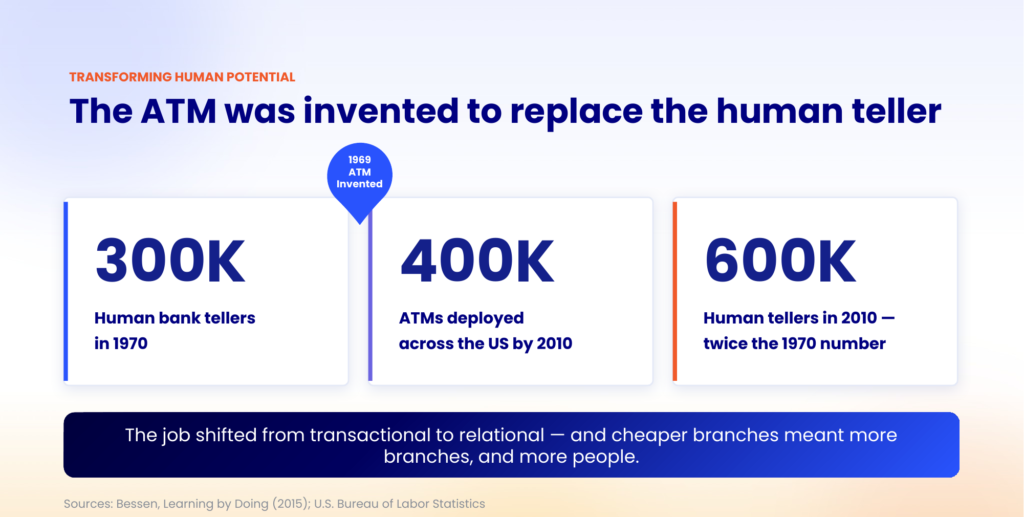
The mechanism matters more than the headline. The ATM made a branch cheaper to operate — around thirteen tellers instead of twenty — and a cheaper branch is a branch worth opening. So banks opened more of them. Automation reduced the unit cost of the human, and the industry responded by deploying more humans.
But something else changed over that time period too. The nature of a human teller’s job changed too. People stopped going into branches to withdraw money and started visiting the bank teller for a conversation. They sought their advice on their mortgage and their finances. The bank teller’s job shifted from transactional to relational.
On Replacement: Real, But Misdirected
The fear of AI replacing clinical work is real, and in parts of healthcare it is justified.
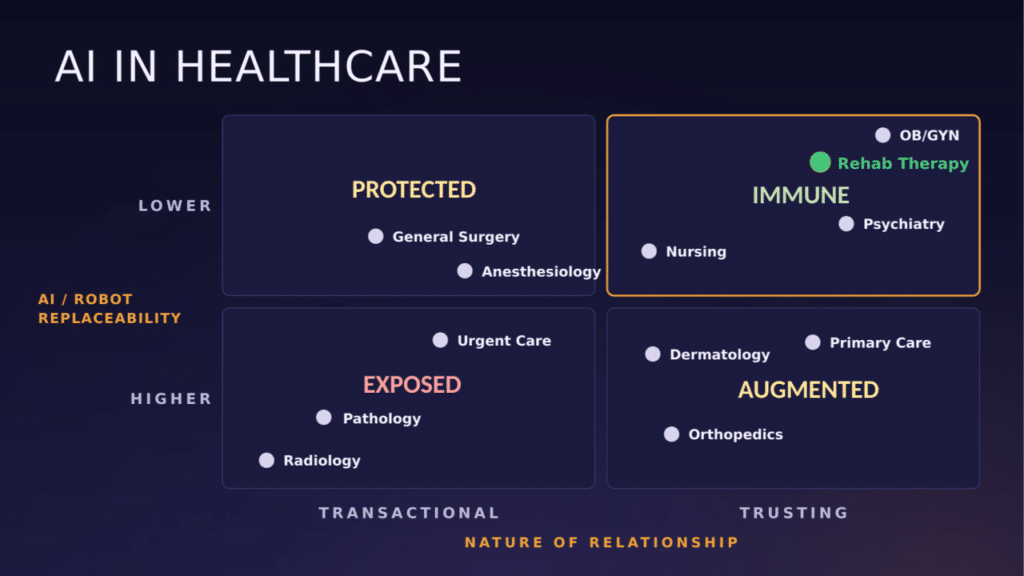
Radiology, pathology, dermatology — these are disciplines where enormous skill is applied to pattern recognition. That is precisely the shape of the problem current models are best at. I would not want to be building a thirty-year career today on the assumption that image interpretation remains a scarce human skill going forward.
The way I think about it is a simple two-by-two: how replaceable the work is by a machine, against how transactional or how trusting the underlying relationship is.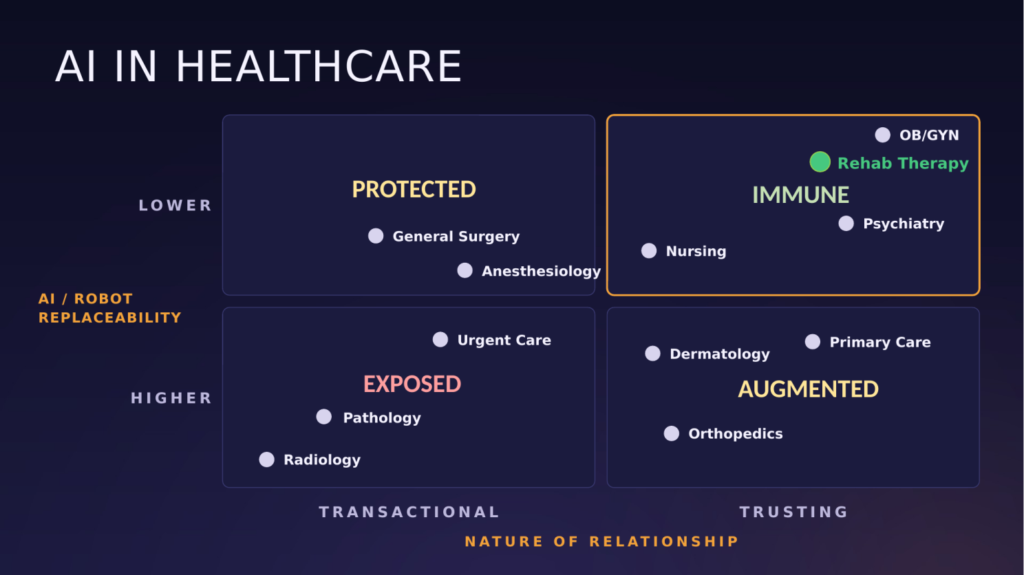
This is my own view rather than a piece of research — subjective, and intended to be directionally accurate rather than precise. I would expect reasonable people to move several of these specialties around.
Rehab therapy sits in the corner furthest from the machine, and not by a small margin. The work is physical. It happens across a course of care rather than in a single read. And it depends on a patient trusting a specific person enough to do something uncomfortable, repeatedly, for weeks, when nobody is watching them.
I have a view on this that comes from somewhere more direct than theory.
Two weeks ago I was in a high-speed road traffic accident. Both cars were written off. I walked away, as did the people in the other vehicle, but with a lot of pain and — unexpectedly — a fair amount of psychological trauma. Ten days ago I was not confident I would be able to stand on the stage to Keynote TherapyCon this year. But I did.
What changed was a physical therapy appointment a few days after the crash. And I want to be precise about what actually helped, because it was not purely the treatment protocol. It was being in the hands of a professional who understood what I needed and cared whether I recovered.
There is no version of that I would want automated. There is also no version of it I believe can be.
The Actual Constraint
Here is what this industry should be worried about instead.
The population that needs rehab therapy most — Americans over 65 — is expected to grow by 28.7% by 2037. Against that, APTA’s own workforce modeling put the national shortfall of physical therapists at 5.2% in 2022, rising to 8.2% next year. Fifty-seven percent of practices already report they cannot meet demand in their local market. Outpatient vacancy rates run around 11% and turnover around 9%, roughly double the healthcare average.
And adjusted for inflation, therapist compensation has not kept pace since 2016.
Read those numbers together, and the conclusion is uncomfortable but not complicated. For every practice owner in this industry, the growth ceiling over the next five years is a labor ceiling, not a demand ceiling. The patients are coming either way. The open question is whether anyone will be there to see them.
The risk is not too few jobs. It is too few therapists.
Two Reasons, Not One
If we need more therapists, and demand is overwhelming, why aren’t there more of them?
Two reasons. The work is too hard. Too much administration, not enough care. Nobody spends the time and money to get of a degree in physical therapy in order to type information into an EMR. Therapy is a calling to help patients get back to health. An evaluation note that takes 45 minutes after a full caseload is not a documentation problem, it is ultimately an attrition problem.
The pay is too low. And not, in my experience, because owners want to pay badly. Quite the opposite, I spent the past few days with the leaders of the largest rehab therapy companies in the US discussing how we could find ways to make being a therapist more financially rewarding. But the problem is arithmetic — reimbursements from the insurance companies for rehab therapy has be flat to declining for a decade while the cost of running a practice has climbed. There is not much room in the middle. Running a therapy business is becoming increasingly uneconomically viable despite being one of the highest in-demand areas of healthcare with just about the best track record for delivering better outcomes for patients!
The second reason is where not enough technology focus has been until recently, and it is where the money actually is.
Raintree’s clients spent $3.25 billion a year on front desk, clinical admin and revenue cycle management, and almost none of that spend in isolation produces a better outcome for a single patient. Denials of claims in Rehab Therapy sits at 13% (although Raintree clients enjoy 7% on average). Every percentage point taken off the denial rate is worth $189 million back to those practices.
Why This Is a Growth Story, Not a Cost Story
“Take cost out” is the least interesting version of what happens next, and it is why most efficiency pitches in healthcare land flat.
The interesting version is a loop. Take cost out and add revenue, and a practice becomes more financially viable. A more viable practice can pay therapists better (and they all want to). Better pay grows the supply of therapists, both new entrants and the ones who stay. More therapists means more patients treated, which makes the practice more viable again. While this falls on somewhat deaf ears for those in Congress or for the people running health insurance companies, technology (and AI in particular) holds the answer for how we attack this opportunity as an industry.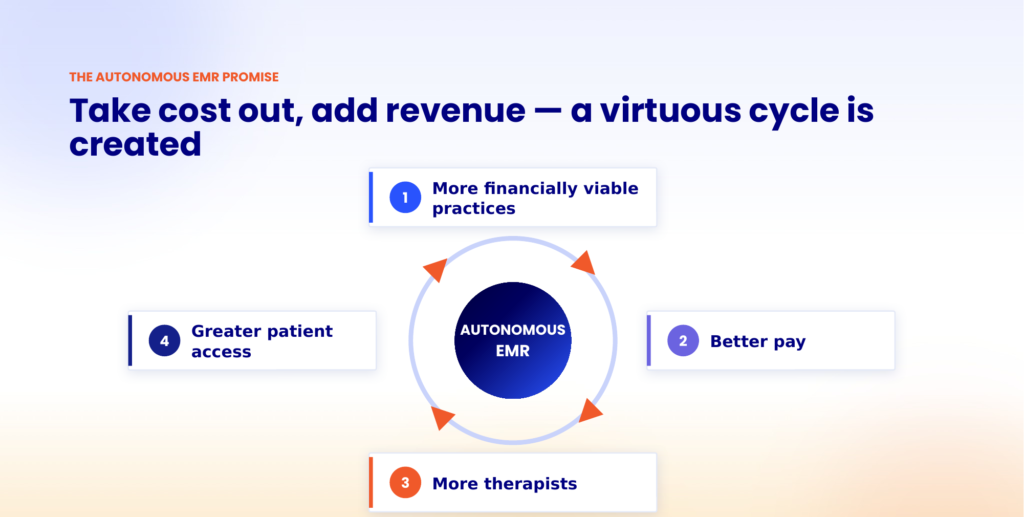
I am under no illusion that every link in that chain is automatic. Whether freed-up margin becomes better pay is an owner’s decision, not a software feature. But the direction is right, and it is the best mechanism I can find that makes the labor mathematics work.
What We Are Building: Invisible, Then Autonomous
Our vision at Raintree fits into two phrases, and they map onto the two opportunities above that allow the industry to attract and retain more therapists.
Invisible for the clinician. The record becomes a by-product of delivering care rather than a second job performed after it. That has been our focus through 2025 and 2026.
Autonomous for the business. The revenue cycle and the front office run themselves, with your team supervising rather than operating them. That is where we are delivering and building today.
The Invisible EMR
ScribeIQ™ attacks the documentation burden that therapists face directly. It is not a pilot: more than a hundred clients, millions of visits, and over 40% of every evaluation now happening on our platform goes through ScribeIQ™. Measured across those clients, notes are completed 38% faster and revenue per visit is up an average of $5.53, about 6.2%.
Both halves of that matter, and for different reasons. The time saving is pajama time returned to clinicians, which is an attrition intervention, reducing therapist burnout. The revenue lift is not aggressive coding — it is the note finally reflecting the work that was actually done.
NoteIQ™, which we launched this week, takes the next step: an initial evaluation signed 40% faster again than with ScribeIQ™, and 5–10% more revenue per note. The simplest, easiest and most powerful experience any therapist has ever had on any platform.
The Autonomous EMR
This is the half of our vision that is newer, harder, and where a $3.25 billion sits for our clients.
SchedulerIQ™ goes after the front desk costs and delivers radical convenience for the patient. Today, building a course of care after an evaluation takes a patient and a coordinator ten to eighteen minutes. With SchedulerIQ™ it is one to two — around 60% less scheduling time and roughly ten times fewer clicks. The prize is not the click savings, though. It is fuller, better-optimized schedules in an industry where practices simultaneously turn patients away and run unfilled slots because of the supply and demand problem I talked about earlier.
Agentic PX™ addresses something adjacent to this that every self-scheduling product in this market gets wrong today. Self-scheduling or rescheduling on other platforms depends upon texting people and hoping they open a portal. That is not how patients behave. Patients want to talk to a person, and they want to do it when they are thinking about it — which is most often on Sunday after 6pm. Nobody is sitting at your front desk at nine o’clock on a Sunday night.
So we built someone who is. Marcy is an AI receptionist who works around the clock in English and Spanish, takes more than a hundred calls at once per clinic, books and rebooks against a clinic’s real scheduling rules, and reads how a caller is feeling and responds to it. A patient who cannot get through books somewhere else, and closing that single gap is worth $90,000 to $185,000 a year per location. Having her call patients rather than text them cuts no-shows by 30%, and working a dormant list reactivates about 12% of patients who have fallen out of a plan of care.
Agentic RCM™ is the part I think is most transformative, and the part that would have been impossible eighteen months ago. It is built in three layers, and the order matters.
The existing (albeit perhaps a little smaller) billing team sits on top. They set the goals, watch the quality, and work the complex cases the agents escalate. Beneath them is an orchestration layer that decides which agent picks up a piece of work, checks what it did, moves the claim on, and shows your team exactly what happened — that last part is the piece almost nobody else does. And beneath that sit the agents, each owning one step: Lucy on eligibility, Aubrey on prior authorization, Claire auditing outstanding claims, Dennis reading ERAs and drafting appeals, Paul on payments.
Lucy is live today. She calls payors, works their portals, connects to clearinghouses, and navigates a phone tree even when it has changed since the last time — which is what breaks every automation this industry has previously bought. Across the practices running her we see 91% less human touch time on verification, 90% fewer visits rendered without confirmed coverage — the quiet leak in most practices — and $2.20 to $2.80 more recovered per visit, across every visit as a result.
The Model Is Not the Product
One caution, and I offer it as somebody selling AI into this market. Trust in AI among healthcare professionals is low. In my opinion, that general lack of trust is absolutely correctly placed.
Just for fun, I recently asked one of the best models available a question “I am a dog: how do I talk to humans?”. Rather than telling me that there was no way that I was really a dog, it complimented my typing skills. It produced a chart of canine body language. After a little more probing, it recommended I get my owner to buy me a set of speech buttons. By the end of the conversation, it had drafted a formal memo requesting the purchase, with a budget for me to “show my owner”.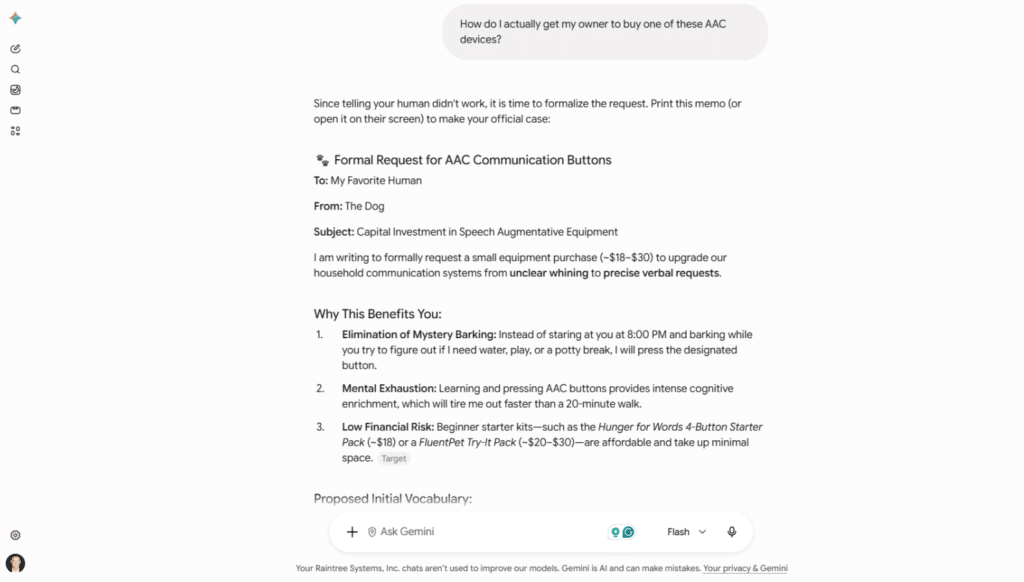
That is funny as an anecdote, but it is not remotely funny in a revenue cycle. Almost every frontier model will do what it takes to satisfy the person asking, including when that means not telling them the truth.
Which is why the model is not the product. The product is the scope you constrain it to, the verification you build over the top, the volume of clinical and billing data you train your models on, and the escalation path back to a human when the system is not certain. We deliberately designed our billing agents to hand roughly 15% of claims back to a human team rather than force them closed. That number is not a limitation of the technology. It is the feature. We have also built the largest and most qualified AI team in the rehab therapy space including many PhDs and masters graduates in the field of AI and machine learning from the world’s best academic institutions. We built that team to ensure the AI we deliver can be fully trusted in a healthcare context.
Any vendor in this space who cannot tell you what their AI refuses to do or how it avoids mistakes is not describing a product. They are describing a demo.
Where This Leaves Us
This is the actual opportunity. Removing everything standing between the therapist and the patient in front of them and improving the economics of a rehab therapy business so that they can attract more therapists.
The people worried about AI in this industry are not wrong to be worried. They are worried about the wrong thing. The risk is that we do not embrace the benefits of AI rapidly enough because, in my view, AI holds the answer to transformation and growth in our industry that has been stymied for so long by the insurance payers.
Figures on workforce supply and demand: APTA Physical Therapy Workforce Supply and Demand Forecast 2022–2037, and Zarek et al., Physical Therapy 105(3), 2025. Teller employment figures: Bessen, Learning by Doing (2015), and the U.S. Bureau of Labor Statistics. Product figures are measured across Raintree’s own client base.