PFS Proposed Rule 2027 Decoded

Here is a breakdown of the key takeaways, operational impacts, and tactical next steps for physical therapy (PT), occupational therapy (OT), speech-language pathology (SLP), and applied behavior analysis (ABA) practices.

Navigating the 2027 Proposed Physician Fee Schedule Rule: Key Takeaways for Therapy Practices

The Centers for Medicare & Medicaid Services (CMS) released the 2027 Proposed Physician Fee Schedule (PFS) rule, signaling notable shifts across revenue cycle management (RCM), clinical documentation, and MIPS quality reporting. In a recent webinar, Jenna Geyer (Senior Product Manager for Regulatory and Compliance) and Catherine Rigda (Senior Product Manager and Physical Therapist) unpacked the critical updates that outpatient therapy practice leaders need to prepare for.

Here is a breakdown of the key takeaways, operational impacts, and tactical next steps for physical therapy (PT), occupational therapy (OT),

1. Revenue Cycle & Billing Modifications

Changes to the Medicare billing formula under the proposed rule will impact practice reimbursements across four main areas: indirect practice expense allocations, removal of the indirect practice cost index, the Practice Expense (PE) stabilization factor, and modifier methodology updates.

  • Overall Financial Impact: The net effect of Practice Expense (PE) RVU adjustments is projected to be slightly negative for speech therapy practices, while physical and occupational therapy practices will see a mixed but ultimately slightly positive outcome.

  • Conversion Factor Reductions: Both fee-for-service (non-qualifying APM) and Alternative Payment Model (APM) participants will experience slight decreases in the conversion factor used to calculate direct dollar reimbursements.

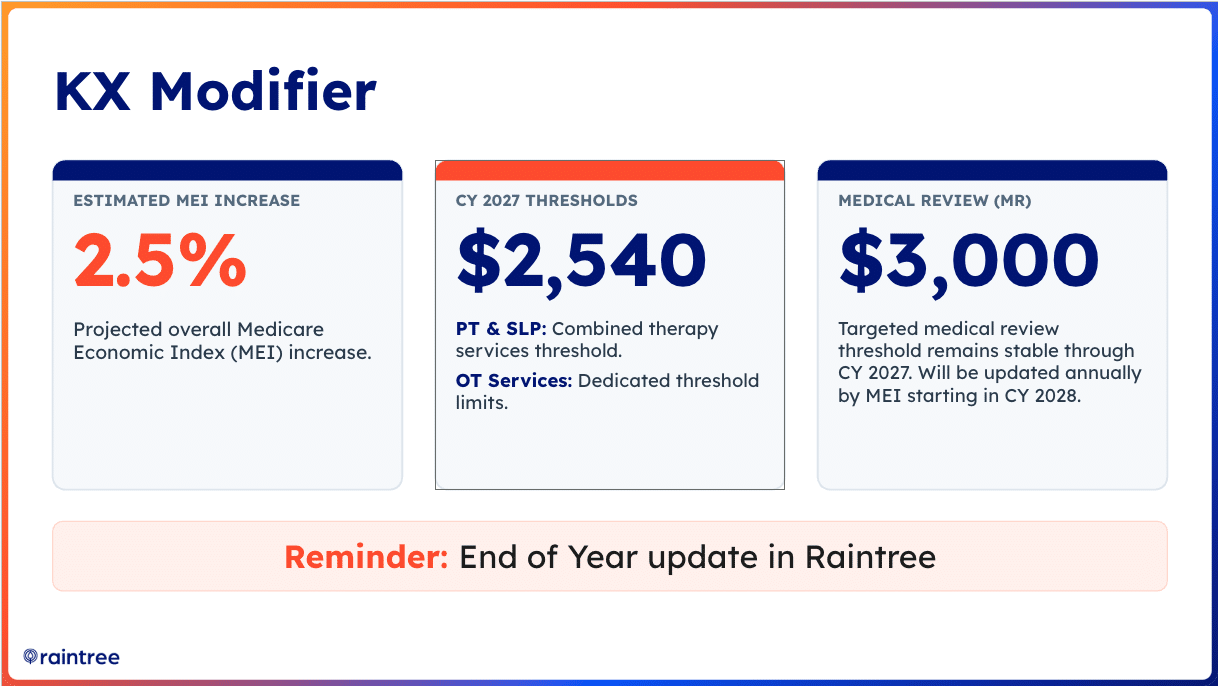
  • KX Modifier Thresholds: Driven by a 2.5% increase in the Medicare Economic Index (MEI) inflation rate:

    • The financial threshold for PT and SLP combined is set at $2,540.

    • The threshold for OT separately is set at $2,540.

    • The targeted medical review threshold is set at $3,000, with annual MEI-indexed adjustments planned to begin in 2028.


Screenshot 2026 08 31 At 3.21.11 Pm

2. Remote Therapeutic Monitoring (RTM) & Telehealth Updates

CMS is proposing tighter requirements around remote care delivery while extending key flexibilities.

  • Direct Employee Requirement for RTM: CMS proposes that RTM services paid by federal payers must be furnished directly by clinical staff who are direct employees of the billing practitioner or practice. Practices currently contracting RTM care coordination out to third-party vendors will need to re-evaluate their staffing models for federal patients.

  • Established Patient Mandate: RTM services must be provided exclusively to established patients who have already completed an evaluation and established a plan of care.

  • Telehealth Extensions & Modifiers: Telehealth flexibilities instituted under emergency provisions are extended through 2026. New billing modifiers include BC for Incident To telehealth services and BB for contract service providers (which mandates that the practitioner or physician own the platform used for delivery).

3. Deep Dive: Speech-Language Pathology (SLP) Rule Overhaul

Key Changes Coming to SLP Billing in 2027
SLP Billing Update

Key Changes Coming to SLP Billing in 2027

What providers need to know about the retirement of CPT 92507 and the new SLP coding structure.

1

The Retirement of CPT 92507

The Change: The long-standing, untimed 92507 code is being deleted from the AMA CPT codebook.
Effective Date: December 31, 2026.
The Impact: It will no longer be a valid billing code for any payers starting in 2027.
2

The New Domain-Based Timed Codes

The Structure: Replaced by a new family of timed codes structured around 5 key SLP domains.
30 min
Initial Unit
Base code covering the first 30 minutes. Requires at least 15 minutes of direct treatment.
+15 min
Subsequent Unit
Add-on code covering each additional 15 minutes. Requires at least 7.5 additional minutes.
The Shift: Moves SLP billing from flat-rate per-session reimbursement to resource-based, time-driven reimbursement.
3

The Pediatric Exception: Code GSLPP

The Code: CMS has proposed a new HCPCS G-code (GSLPP).
The Audience: Exclusively for the pediatric population (ages 0–21).
The Function: Acts as an exact, untimed replacement for 92507, mirroring its 1.3 RVU value.

4. Valuation & Reimbursement Impact

  • The work RVU for former code 92507 was 1.3 (based on an untimed 60-minute service workload).

  • Proposed initial 30-minute domain codes range between 0.92 and 1.0 RVUs.

  • Subsequent 15-minute add-on codes range between 0.44 and 0.50 RVUs.

  • Financial Effect: Standard 30-minute sessions using a single initial code will experience reduced reimbursement compared to 92507. However, delivering longer sessions, adding 15-minute units, or treating across multiple domains in a session presents opportunities to offset revenue declines.

  • Rules: These codes are designated as “Always Therapy” (requiring the GN modifier for Medicare). Base 30-minute codes will be subject to Multiple Procedure Payment Reduction (MPPR) when two initial codes are billed in the same session.

CMS HCPCS Code GSLPP & Dual-Coding Complexity

CMS has proposed an alternative HCPCS G-code—GSLPP—specifically for the pediatric population (up to age 18 or 21). This code serves as an exact replacement for 92507, maintaining a 1.3 RVU crosswalk representing 60 minutes of work.

Operational Challenge: Because GSLPP is a CMS creation, non-federal payers, state Medicaid programs, and commercial insurers are not required to adopt it. Practices face potential “dual-coding” operational risks, such as secondary payer crossover denials, authorization misalignments, and increased provider documentation errors.

5. ABA & Specialty Code Adjustments

  • Applied Behavior Analysis (ABA): Category III T-codes (0362T and 0373T) have been deleted. CPT codes 97151 through 97158 received minor description updates for clarity, and new standard time-based add-on codes were introduced to support assessments of harmful behavior and care delivered by two technicians.

  • Biofeedback: CPT 90901 has been restructured into a base code, accompanied by a new 15-minute add-on code to better align with pelvic floor retraining structures.

6. MIPS & Quality Reporting Shifts

CMS continues to push toward MIPS Value Pathways (MVPs) ahead of a complete sunset of traditional MIPS scheduled for performance year 2029.

  • MVP Renaming & Measure Swaps: The Musculoskeletal Care MVP has been renamed to Rehabilitative Support. FOTO measures are being retired and replaced with PROMIS patient-reported outcome measures (e.g., QuickDASH, Neck Disability Index).

  • MIPS Transition Timeline: Performance years 2027 and 2028 will serve as formal transition years where practices are strongly encouraged to adopt MVPs before traditional MIPS is phased out entirely in PY 2029.

  • New AI Improvement Activity: CMS added an Improvement Activity (IA) for utilizing AI tools in clinical care, requiring clinicians to adhere to health system guidelines and maintain human clinician review over AI-generated documentation.

  • Promoting Interoperability: Electronic prior authorization mandates have been delayed to performance year 2028; for PY 2027, electronic prior authorization will serve as a 10-point bonus measure. Additionally, CMS proposed removing the Security Risk Analysis attestation requirement in 2027 to ease administrative burden.

Action Plan for Practice Leaders

  1. Educate Speech Therapists early: Train clinicians on domain-based documentation, accounting for timed units, and navigating 8-minute/substantial portion rules before 92507 is retired.

  2. Review Payer Contracts & Authorizations: Check local Medicaid and commercial insurer stance on whether they will adopt new timed domain codes or the pediatric GSLPP code, and adjust authorization workflows accordingly.

  3. Assess RTM Staffing: If using outsourced third-party vendors for Medicare RTM care coordination, prepare contingency plans to bring federal RTM monitoring in-house.

  4. Prepare Technology Infrastructure: Ensure EHR and billing software (such as Raintree) can handle dual-coding logic automatically—allowing clinicians to document care by domain while background rules generate the correct CPT or GSLPP codes based on individual payer rules.

Blogs are created for educational and informational purposes only.  The information provided does not constitute or, is not intended to constitute, legal or medical advice. When you read this information, visit our website, or access our materials, you are not forming an attorney-client, provider-patient, or other relationship with us.

Table of Contents

Last Updated:
September 4, 2026

Rehab Therapy Insights in Your Inbox

This field is for validation purposes and should be left unchanged.
Consent(Required)

Get Rehab Therapy Insights in Your Inbox

This field is for validation purposes and should be left unchanged.
Consent(Required)