
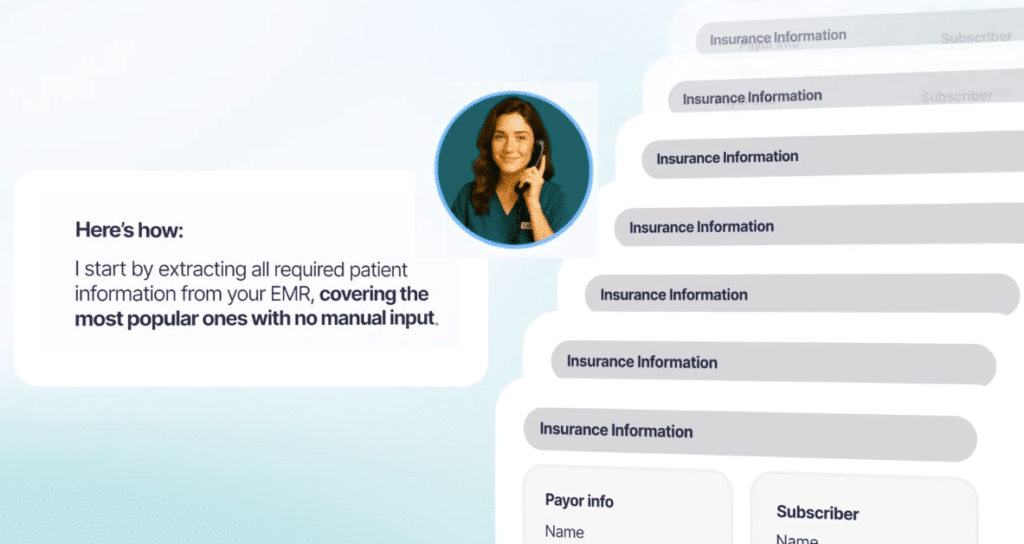
Eligibility checks, benefits verification, payer phone trees, claim follow-ups, denials and appeals: the administrative machinery of the revenue cycle consumes hours that no one set out to spend when they entered this field.
Raintree’s acquisition of Spike Technologies is a direct response to that problem. By bringing genuinely agentic AI voice technology into the leading platform for rehab therapy, we are transforming the most manual, phone-based parts of revenue cycle management, starting with eligibility and benefits verification and building toward a broader vision of autonomous revenue cycle management (RCM). This is a look at what that technology is, what it does today, and what it means for the way a rehab therapy practice runs.
What is agentic RCM?
Agentic revenue cycle management (RCM) is carried out by AI agents that understand context, make decisions, and complete multi-step work on their own, rather than following a fixed script. Instead of a rules engine that executes one predefined path, an agentic system holds an objective in mind and adapts to whatever it encounters on the way to that goal.
That distinction matters more than it might sound, because the revenue cycle is not a predictable environment. As Spike co-founder and CEO Povilas Gudzius puts it in an upcoming episode of the Therapy Matters podcast, the work spans “Fifty states, different regulations, different payers, they have their own plans, they have their financial models,” and the rules shift constantly. A system that can only follow a script has to be rewritten every time the ground moves. A system that reasons toward an objective does not.
Why the revenue cycle is the costliest work in rehab therapy
Revenue cycle work remains one of the most labor-intensive parts of healthcare, and rehab therapy feels it acutely. Physical therapy practices face an average claim denial rate of roughly 13%, and nearly three-quarters of those denials must be appealed. Front-desk teams spend ten minutes or more per patient on prior authorization alone, and many practices have added administrative staff simply to keep pace.
For Raintree CEO Nick Hedges, it is the clearest pain point in the industry. “There’s one that stands out more than anything else, and that is the amount of time that is spent getting paid,” he said. The cost is both human and financial. “Our clients are spending 7% or more of what they collect on just human costs and systems, in order to run their revenue cycle.”
Industry analyses estimate that AI and automation in the revenue cycle represent significant potential savings across healthcare. The opportunity, in plain terms, is to return that time and money to patient care.
RPA versus agentic AI: Why rules-based automation breaks
Practices have tried to automate this work before. The last decade moved from manual labor, to offshore teams, to robotic process automation (RPA): software bots that mimic a person clicking through a portal. Some practices reduced costs meaningfully that way. But the approach has a structural weakness.
“Every time a payer changes a rule, or a phone tree changes, these RPA systems were breaking,” Nick said. A bot that scrapes a portal works until the portal moves a single element on the page, and then it stops, often silently. “You do not want to run your entire financial system based on a system that can break.” When the bot fails without anyone noticing, claims stop flowing, and the cost compounds for as long as it takes to discover and repair.
Spike’s agentic model was built to surpass the RPA model from the start. “You can’t script it,” Povilas said of the problem space. The team’s answer was what they call objective-oriented orchestration: an agent that holds a goal and coordinates a range of specialized agents to reach it, rather than following a prescribed set of steps. “It has different ways, paths, and a constellation of agents that go after the goal, rather than a prescribed path of how to get there. That’s the key differentiator.”
Voice is where this is hardest, and where it matters most. A phone tree can be mapped. A live human conversation cannot. “Once you get into a human conversation, rules don’t cut it,” Nick said, “because a human can say pretty much anything, and you need a system that’s able to adapt to whatever’s being said back to it.”
Why RCM should be native to the EMR
A reasonable question is why any of this needs to live inside the EMR rather than beside it, connected by an API. The answer comes down to data, context, and speed.
Raintree holds four decades of proprietary revenue cycle data: not only claims, but the process metadata around them, the record of what happened at each step and why a claim resolved the way it did. “That information is way beyond just the phone number to call or the policy ID of the patient,” Povilas said. An AI system trained and operating on that depth of data can cross-check its own work and reach answers faster than one working from a thin external feed.
Latency is the other reason. Voice conversation is instantaneous, and the technology behind it has to keep up. “If there’s any time lag in a voice conversation, it degrades trust immediately,” Nick explained. A natural exchange draws on thousands of data points in real time, and pulling that volume across an API introduces exactly the delay that makes an AI voice agent feel like a machine. “The time it takes for data to travel makes high-fidelity voice AI almost impossible without being native.” Spike’s team calls the discipline of assembling that live picture “context engineering,” and it depends on sitting directly on the data rather than querying it from a distance.
Nick frames the destination as an invisible EMR: a system where, as he describes it, “everyone gets to do the job they wanted to do, and the EMR, without anyone tapping a keyboard, does the things people don’t want to do because their time is better spent elsewhere.”
The humans managing RCM don’t go away
Automation of this kind works alongside people, not in place of them. “There needs to be a human in the loop,” Nick said. “Humans who are orchestrating at the highest level,” including for the edge cases that agentic AI is not yet ready to handle on its own. A practice that plans to remove its billing team entirely, he cautions, is planning wrong.
What changes is the nature of the work. Raintree has already seen this pattern with clinical documentation, where therapists no longer spend visits typing notes and instead spend that time with patients. The same logic extends across the front office, RCM, and billing: as the repetitive work lifts away, the roles that remain become more interesting, and staff capacity shifts toward the reasons people entered rehab therapy in the first place.
Where the Raintree EMR goes next
Raintree is the only ONC-certified EMR built specifically for rehabilitation therapy, managing more than 50 million patient visits a year across 8,500+ clinics, and maintaining SOC 2 Type II certification. Bringing Spike’s agentic voice technology into that foundation is a step toward operating the revenue cycle, and eventually the wider practice, with far less manual effort.
The first look at Raintree’s Agentic RCM™ solutions will be unveiled at TherapyCon in Austin, August 19 to 21. Nick Hedges’ keynote, “The Dawn of the Autonomous EMR,” will reveal how AI-enabled operations change efficiency and administrative burden in rehab therapy.
If you run a PT, OT, or SLP organization and want to understand the future of the invisible EMR, you can also watch the keynote virtually here.