
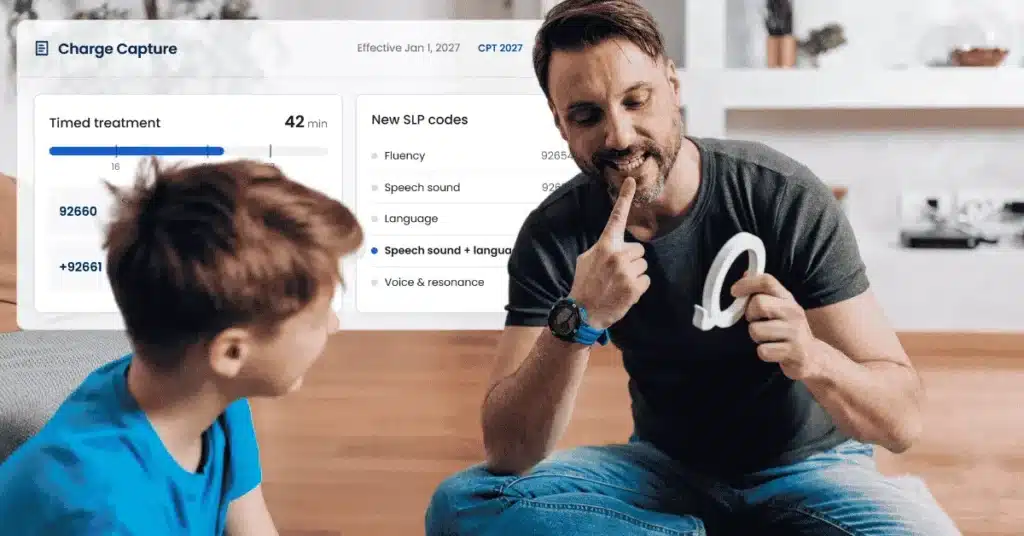
💡 Quick Answer Effective January 1, 2027, CPT 92507 will be deleted and replaced by 10 time-based codes covering five treatment domains, and CMS has finalized Medicare payment for the new codes along with a pediatric HCPCS code, G0903. Practices should prepare documentation, charge capture, fee schedules, payer rules, staff education and system configuration now, while monitoring payer guidance and forthcoming coding edits.
For years, CPT 92507 has served as the primary code for individual speech, language, voice, communication and auditory-processing treatment. Beginning January 1, 2027, that familiar structure changes significantly.
Kathryn Rigda, PT, and Megan Drago explain why the shift is not simply a code-table update. It changes how services are described, how time is captured, how reimbursement may vary by treatment domain and how clinicians, billers and systems must work together.
What is replacing CPT 92507?
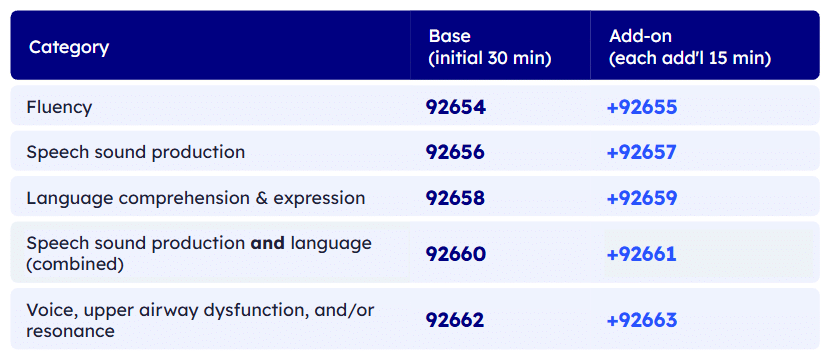
The American Medical Association is replacing speech therapy CPT code 92507 with 10 time-based codes, 92654 through 92663, that more specifically describe individual treatment across five clinical domains: speech sound production, language, fluency, voice and combined speech-language treatment. Each domain includes a base code for the initial 30 minutes of treatment and an add-on code for each additional 15 minutes.
The AMA published the new codes in the CPT 2027 code set, effective January 1, 2027, and CMS finalized Medicare payment for all 10 in the CY 2027 Physician Fee Schedule final rule released November 4, 2026. Because the new family is time-based, clinicians will need documentation that supports the service domain and the time reported. Practices will also need a consistent method for translating treatment activity into the correct base and add-on codes.
Why the financial impact may vary
The new codes do not all carry identical relative-value inputs. Differences in work and practice-expense valuation can change estimated payment depending on the code combination and session length.
The CY 2027 final rule also lowers the Medicare conversion factor to approximately $32.63, about 2.3% below 2026, which reduces payment across the board. In practical terms, national Medicare payment for the five initial 30-minute codes falls roughly between $50 and $71 depending on the treatment domain, and each additional 15-minute add-on pays roughly $23 to $28. For comparison, 92507 pays about $76 nationally in 2026 regardless of session length. In practice, a 30-minute session billed with a single base code will generally pay less than 92507 does today, while a longer session with add-ons can pay more. Actual payment will also depend on geographic adjustment, payer policy, multiple-procedure rules and the specific codes billed.
That means a practice should not rely on one national reimbursement estimate. Model its own high-volume visit patterns using current payer mix, expected code selection, session length and contractual rates.
The pediatric twist: proposed HCPCS code GSLPP
In the CY 2027 final rule, CMS finalized a pediatric-focused HCPCS code, G0903 (referred to as GSLPP in the proposed rule), in response to concerns that the new CPT family may not fully reflect the time and intensity involved in pediatric treatment. G0903 is an untimed individual treatment code covering speech, language, voice, communication and/or auditory-processing disorders, limited to once per patient per day, and it applies specifically to pediatric patients, from birth through 21 years of age. Although the definition closely mirrors 92507, G0903 carries a reduced valuation: at approximately $66 nationally, it pays less than 92507 does today, and less than the same hour of treatment billed under the new timed codes.
CMS also designated G0903 an “always therapy” service subject to the therapy multiple procedure payment reduction. Because G0903 is a Medicare code created outside the AMA CPT process, Medicaid and commercial payers are not required to recognize it. Practices should not assume payer adoption until individual payers communicate their approach, and should watch for the NCCI and MUE edits expected with the January 2027 files.
Prepare for a dual-code environment
Even with federal policy now final, commercial and Medicaid payers may not adopt the same codes or timing at the same pace. Practices may need to manage different rules for the same clinical service depending on payer and patient population.
The safest operational design separates clinical documentation from payer-specific claim logic. Clinicians should document the treatment domain, medical necessity and time consistently. The billing system should then apply payer rules, code combinations, add-on logic and effective dates where automation is reliable.
Six areas to address before January 1, 2027
1. Documentation standards
Define how clinicians will document the treatment domain and total time. Use examples that distinguish speech, language, fluency, voice and combined treatment without turning notes into a coding checklist.
2. Charge capture and picklists
Understand how your EHR and billing system will present the new codes and manage code selection, and what workflow changes to expect for both providers and billers. Clinicians should be able to choose the appropriate base service without sorting through unnecessary add-on codes, and defaults should be configured so the selection experience stays simple.
3. Time and unit calculation
Understand how your system calculates the initial 30-minute period and each additional 15-minute increment, and where in the workflow that calculation happens. Test sessions near unit thresholds and confirm the organization’s interpretation against official coding guidance and the NCCI edits expected in early 2027.
4. Fee schedules and contracts
Load the new codes, model expected reimbursement against the final Medicare rates and identify contracts that reference 92507 directly. Ask payers when they will accept the new codes, whether they will recognize G0903 and how authorizations will transition.
5. Existing authorizations
Determine whether authorizations issued under 92507 will remain valid after the code is deleted or require replacement. Build a payer-specific tracker for outstanding patients rather than waiting for January denials.
6. Staff education and testing
Train clinicians, front-office teams and billers on the same workflow. Test documentation, code selection, claim output and remittance handling in advance, then monitor early claims by payer.
A readiness checklist for practice leaders
• Inventory every workflow, template, fee schedule, authorization rule and report that currently references 92507.
• Assign one cross-functional owner across clinical, billing, IT and operations.
• Build payer-specific adoption and authorization questions now.
• Model revenue impact across common session lengths and treatment domains.
• Configure the new codes in a test environment and validate base-plus-add-on calculations.
• Create clinician documentation examples and short decision support.
• Review the final CY 2027 rule, ASHA guidance, NCCI edits and payer bulletins before locking production rules.
Frequently asked questions
When will CPT 92507 be deleted?
The AMA CPT 2027 code set deletes CPT 92507 effective January 1, 2027, when the new time-based treatment codes, 92654 through 92663, take effect.
How many codes will replace 92507?
Ten codes, 92654 through 92663, replace it across five treatment domains. Each domain has an initial 30-minute code and an add-on code for each additional 15 minutes of treatment time.
Is GSLPP final?
Yes. CMS finalized GSLPP as HCPCS code G0903 in the CY 2027 Physician Fee Schedule final rule released November 4, 2026, effective January 1, 2027, for Medicare Part B. Medicaid and commercial payers set their own policies and are not required to adopt it, and coding edits for the new codes are still forthcoming.
Will every payer adopt the new codes in the same way?
Not necessarily. Medicare, Medicaid and commercial payers may differ in effective dates, authorization handling, payment policies and recognition of HCPCS alternatives such as G0903. Practices should track each payer separately.
The transition away from 92507 will create complexity, but practices can control the consistency of their response. The organizations that begin with documentation, payer readiness and end-to-end testing will be better positioned than those that treat the change as a last-minute billing update.
Important: This article reflects information available as of the CY 2027 Medicare Physician Fee Schedule final rule released November 4, 2026. It is educational and does not replace current AMA, CMS, ASHA or payer-specific coding guidance.
Source notes
• Presentation: “Goodbye 92507, Hello Time-Based Billing (& the New Pediatric Twist),” Kathryn Rigda, PT, and Megan Drago at TherapyCon 2027.
• ASHA, “New SLP treatment codes replacing 92507”
• CMS, CY 2027 Medicare Physician Fee Schedule final rule
• CMS, CY 2027 Medicare Physician Fee Schedule proposed rule fact sheet